


 Contact us

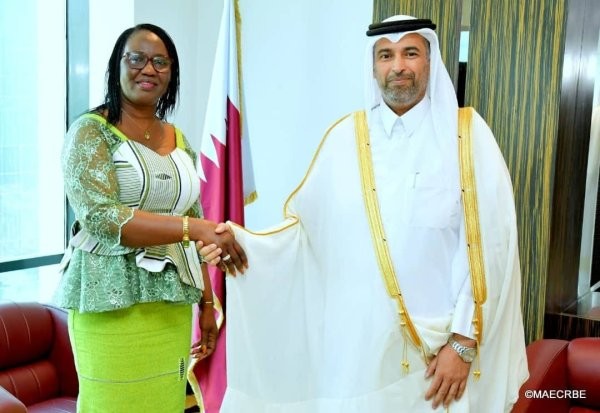
Burkina Faso's head of diplomacy in Doha to obtain humanitarian and security support from Qatar against jihadist groups.
Jun 30, 2023 · Issaka OUEDRAOGO
Olivia ROUAMBA, Minister of Foreign Affairs of Burkina Faso, stayed in Doha, Qatar from June 19 to 20, where she held talks with her Qatari counterpart, Sultan Bin Saad Al Muraikhi. During her stay, she advocated for security support from Qatar to her country to counter jihadist groups, including a recent attack on June 26, 2023, which left dozens of victims in the ranks of the army and its civilian auxiliaries. Burkina/Security: 40 terrorists neutralized and 31 soldiers and 3 VDP killed in an attack - leFaso.net Minister Rouamba's visit to this very wealthy gas emirate illustrates the extension towards the Persian Gulf of the strategy driven by the rise to power of Captain Ibrahim Traoré to diversify Burkina Faso's security partnerships on the international stage. The transitional military authorities are thus emphasizing their desire to redirect the foreign policy of this country, previously supported by the Western bloc, particularly France, towards the Sino-Russian bloc. The recent trip in May 2023 by Prime Minister Apollinaire de Tambela to Venezuela is another illustration of this. Upon his return, he stated in an interview with the Burkinabe media that he had been able to observe the political and economic engineering deployed by a country under international sanctions. This is an interesting observation, since the threat of additional ECOWAS sanctions against Burkina Faso remains current due to the lack of signals of political will from the military-dominated government to hold the elections normally scheduled for 2024. These three countries were suspended from the decision-making bodies of the West African organization after the coups that brought military leaders to power. In fact, the regional organization has decided to put the calendar of elections in Mali, Guinea and Burkina Faso back on the agenda of its summit on July 9. The acceleration of the Burkinabe authorities’ push to diversify economic and security partnerships could be motivated by the need to avoid diplomatic and economic isolation in the event of sanctions or a complete break with former Western support. Burkina has thus approached countries such as North Korea and Russia with a view to purchasing military equipment and materials against jihadist groups whose attacks are not decreasing. These decisions are justified in Ouagadougou decision-making circles in particular by the following argument: The army needs weapons to counter the jihadists. However, acquisitions via traditional Western channels are slowed down or blocked by the states concerned, supposedly out of fear that their equipment will be used for possible human rights violations by Burkinabe security forces and civilian auxiliaries (VDP). It is true that the armed forces have recently been singled out by the media and ECOWAS for their possible involvement in the Karma massacre in April 2023. But the narrative promoted on the Ouagadougou side tends to present these considerations as the will of former partners who have been rejected, determined to punish the transitional authorities for their decision to move closer to countries perceived as strategic adversaries of the Western bloc. Mali, now a key ally of the Burkinabe government with which it seems to share the same visions and discourses, is also trying to move closer to Qatar and other Gulf States in this perspective. As the Africa Intelligence newspaper points out, Qatar had already delivered around twenty Storm-type armoured vehicles to the Burkinabe authorities in 2019. If this partnership with Burkina and Mali were to deepen, it would be a boon for Qatari influence and interests, which seemed to have kept a low profile in the face of Turkey's muscular intrusion, thanks in particular to its military equipment manufacturer Baykar Technologies and its TB2 drones. On this subject, I recommend listening to the excellent podcast by our collaborator Gabriel Poda: "The TB2 and Turkey's drone diplomacy" broadcast on the podcast Les Afriques En Question(s).
